
April 23,2026
TIME:April 2012
Source: Forbes China
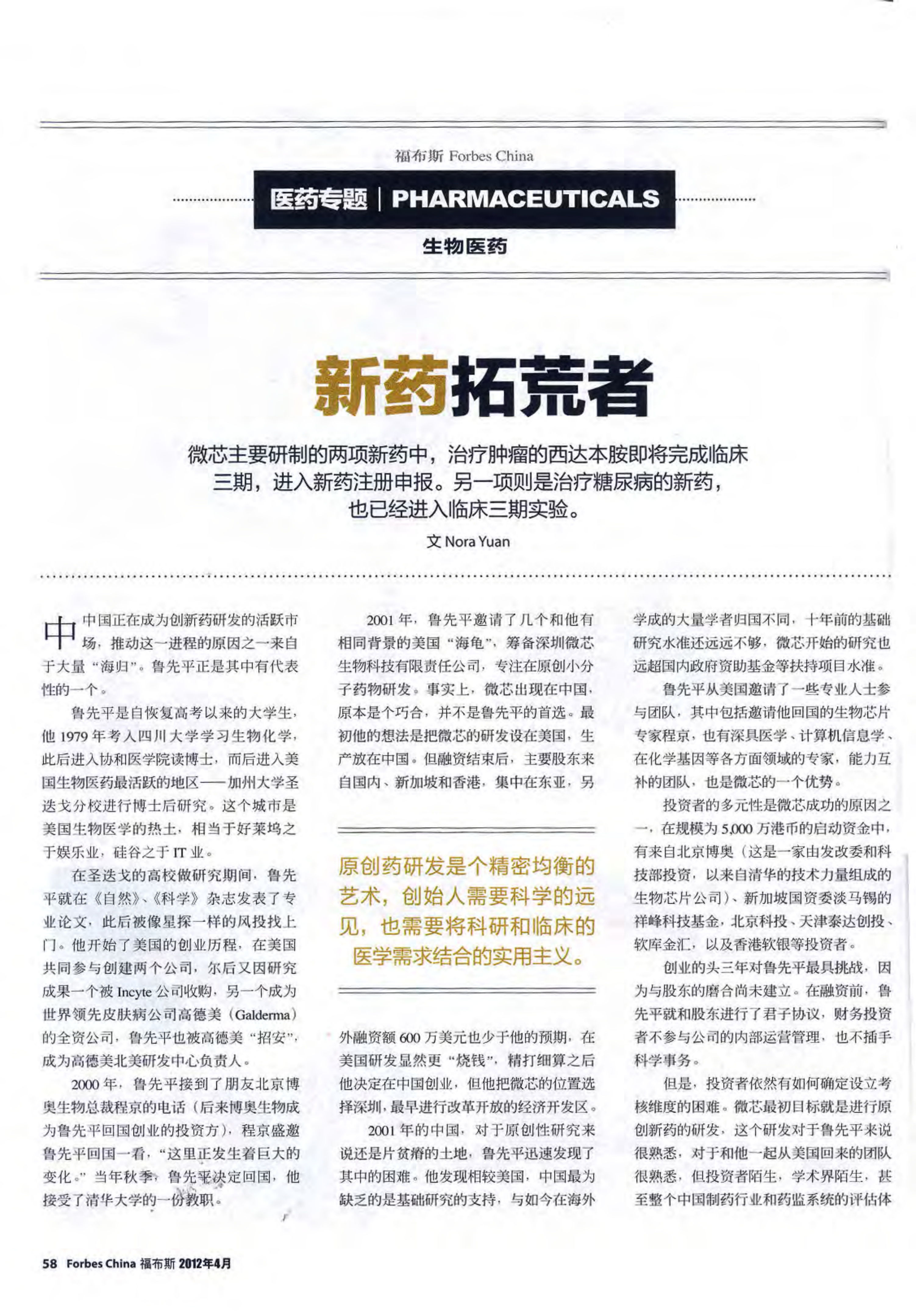

China is becoming an increasingly active market for innovative drug development, driven in part by a wave of “returnee” scientists. Lu Xianping is a representative figure among them.
Lu was among the first generation of university students after China reinstated its national college entrance exam. He enrolled at Sichuan University in 1979 to study biochemistry, later pursued a Ph.D. at Peking Union Medical College, and then conducted postdoctoral research at the University of California, San Diego—one of the most vibrant hubs for biomedical research in the United States, akin to Hollywood for entertainment or Silicon Valley for IT.
During his academic tenure in San Diego, Lu published papers in leading journals such as Nature and Science, attracting the attention of venture capitalists. He went on to co-found two companies in the U.S.; one was acquired by Incyte, and the other became a wholly owned subsidiary of Galderma, a global leader in dermatology. Lu subsequently joined Galderma as head of its North America R&D center.
In 2000, Lu received a call from Cheng Jing, then president of Biochip (later an investor in his venture), inviting him back to China: “Things are changing dramatically here.” That fall, Lu returned and accepted a position at Tsinghua University.
In 2001, he recruited several like-minded U.S.-based Chinese scientists to establish Shenzhen Chipscreen Biosciences, focusing on the discovery of original small-molecule drugs. In fact, setting up the company in China was not his initial plan. He had originally intended to conduct R&D in the U.S. and manufacturing in China. However, after raising $6 million—primarily from investors in mainland China, Singapore, and Hong Kong—and recognizing the higher cost structure in the U.S., he decided to build the company in China, choosing Shenzhen, a pioneer of China’s economic reforms.
At that time, China was still a barren landscape for original drug discovery. Lu quickly encountered significant challenges, particularly the lack of foundational research support—something readily available in the U.S. but largely unfamiliar in China at the time.
By 2002, Lu realized that nearly all societal stakeholders lacked an understanding of the complexity of innovative drug development. Both the necessary resources and supportive policies were scarce. “We felt extremely isolated,” he recalled. Even investors struggled to grasp the nature of innovative drug R&D. Lu described them as “trailblazers,” yet their lack of domain expertise made it difficult to evaluate progress. Trust became critical, as drug development requires sustained investment over decades.
The board brought in external experts to assess Lu and his management team. Lu spent significant time communicating with them in detail, explaining the scientific efforts and helping them understand both the risks and value of innovative drug development. Through persistence, mutual trust was established within the first three years.
“I soon realized that when doing something truly pioneering in China, the biggest challenge is this: when people cannot effectively communicate or evaluate each other at a technical or scientific level, trust becomes the only foundation,” Lu said.
He also credited Chipscreen’s diversified shareholder base as a key factor in its survival. “Otherwise, a company like ours might have been shut down early on in China.” Drug development cycles can span over a decade—far beyond typical venture capital expectations. In a rapidly growing economy, investors often seek quick returns, which partly explains the lack of momentum in original innovation.
From his entrepreneurial experience in the U.S. during the 1990s, Lu learned that a healthy high-tech company requires a diversified ownership structure. This helps distribute risk among investors and provides checks and balances. Over long development cycles, disagreements between founders and management are inevitable, but a diversified shareholder base allows alignment to emerge. Most investors also play strategic or financial roles rather than directly managing operations.
Lu noted that the dominance of single major shareholders has been one reason why China historically lacked companies like Genentech or Amgen. He sees himself as a professional manager rather than emphasizing his founder identity, believing that true technology companies should be run by domain experts, with shareholders contributing at the strategic level.
Though he identifies as a scientist, Lu is far from detached from the real world. He communicates complex scientific ideas with clarity and ease, making them accessible even to non-experts. This ability to “translate science” has been instrumental in gaining support from investors and government stakeholders alike.
In 2004, Chipscreen submitted its first clinical application in China for a novel diabetes drug, followed by its first oncology drug application in 2005. Meanwhile, Chidamide was licensed for development in the U.S. market, and Chipscreen’s early-stage drug risk evaluation platform was adopted by Roche as a screening tool. In 2006, Chipscreen partnered with HUYA Bioscience, granting rights outside Greater China for further development.
Lu describes 2006 as a turning point. The HUYA partnership generated milestone revenues, and collaboration with Roche strengthened its position. By 2007, Chipscreen achieved positive cash flow. In 2009, it became the only chemical drug company among the first recipients of China’s National Major New Drug Innovation Program funding, receiving RMB 15 million. As its pipeline advanced, financial pressures eased.
Today, both of Chipscreen’s leading drug candidates—Chidamide for oncology and a diabetes therapy—have reached Phase III trials, representing later-stage, lower-risk phases of development.
Developing original drugs is a delicate balancing act. Founders must combine scientific vision with practical understanding of clinical needs. Over decades-long development cycles, they must manage risk effectively, translate research into actionable steps, and navigate patent law and regulatory frameworks.
Chen Wen, Vice President of Tigermed, noted that innovative drug development spans scientific research, business strategy, intellectual property, and regulatory approval over decades. It requires multidisciplinary talent—something still scarce in China, where most entrepreneurs specialize in only one area.
Lu emphasized that the goal of entrepreneurship is not pure scientific inquiry but bringing approved drugs to market. “That requires a balanced skill set to manage the entire process,” he said.
In the early years, many members of the founding team returned to the U.S., leaving Lu to carry on. Some described him at the time as “single-handed.” He rebuilt the team locally and continued forward.
Over the following decade, Chipscreen’s leadership team remained remarkably stable—even in functions like finance—contrasting sharply with the volatility seen in many domestic biotech firms. Financial incentives were not the primary driver; due to policy constraints, equity incentives for key team members were only introduced in 2009.
Lu attributes his perseverance to a deep passion for life sciences—a passion he has instilled in his team. Many of the Ph.D. recruits he hired early on have grown into leadership roles. “They are a team that has fought alongside me,” he said. “They share the same passion for life sciences.”
Lu enjoys continuously challenging his scientific thinking. He finds the difficulties of innovative drug development intellectually rewarding. “If someone can create something truly original, their mind must be sufficiently complex,” he often says. Tasks that others find daunting—such as GMP certification—seem straightforward to him.
He leads a life that is deeply engaged yet not obsessive. Since his student days, he has avoided overworking on weekends. Despite years devoted to life sciences, he has maintained personal interests, including photography—capturing butterflies among flowers, Tibetan homes in snowy mountains, and resilient pine trees after snowfall. He also excelled in track and field and volleyball, pursuits that continue to bring him joy.
“We could choose to retire and do what we like,” he said. “But we cannot waste the minds we were born with. We want to dedicate ourselves to work we truly enjoy.”
In his view, whether in China or the United States, with or without founding Chipscreen, he would have chosen the same path.
2026.04.23
2026.04.22
2026.04.21