
April 23,2026
Article Source: NATURE
Original Title:From biochips to drug discovery
Online Archive:https://www.nature.com/articles/nj0181
A biotech/pharmaceutical company specializing in drug discovery and development is unusual in China, where most pharmaceutical companies make generics. Shenzhen Chipscreen Biosciences Ltd., using its own integrated chemical genomics discovery platform, is one of the few companies operating in this area.
Chipscreen was founded in 2001 as a Sino–US joint venture by the company’s director, president and chief scientific officer,Lu Xianping, and other returnees from the US.“The first thing you notice about Shenzhen after living in the US is that it is very beautiful, is much cleaner and has better weather than other Chinese cities,” says Lu.
“More importantly, several years ago Shenzhen began undergoing dynamic commercial development and we liked the strong market economy, which is really pushing us forward,” he says.
In some ways Shenzhen reminds Lu of his former base in California. “I spent 10 years in San Diego, which, like Shenzhen,has an immigrant culture and is very vibrant and innovative.”
The Shenzhen government was very supportive in terms of issuing permits and other paperwork needed to start the company and import the high-tech equipment they needed. Chipscreen also received about $US2.5 million in government research grants.
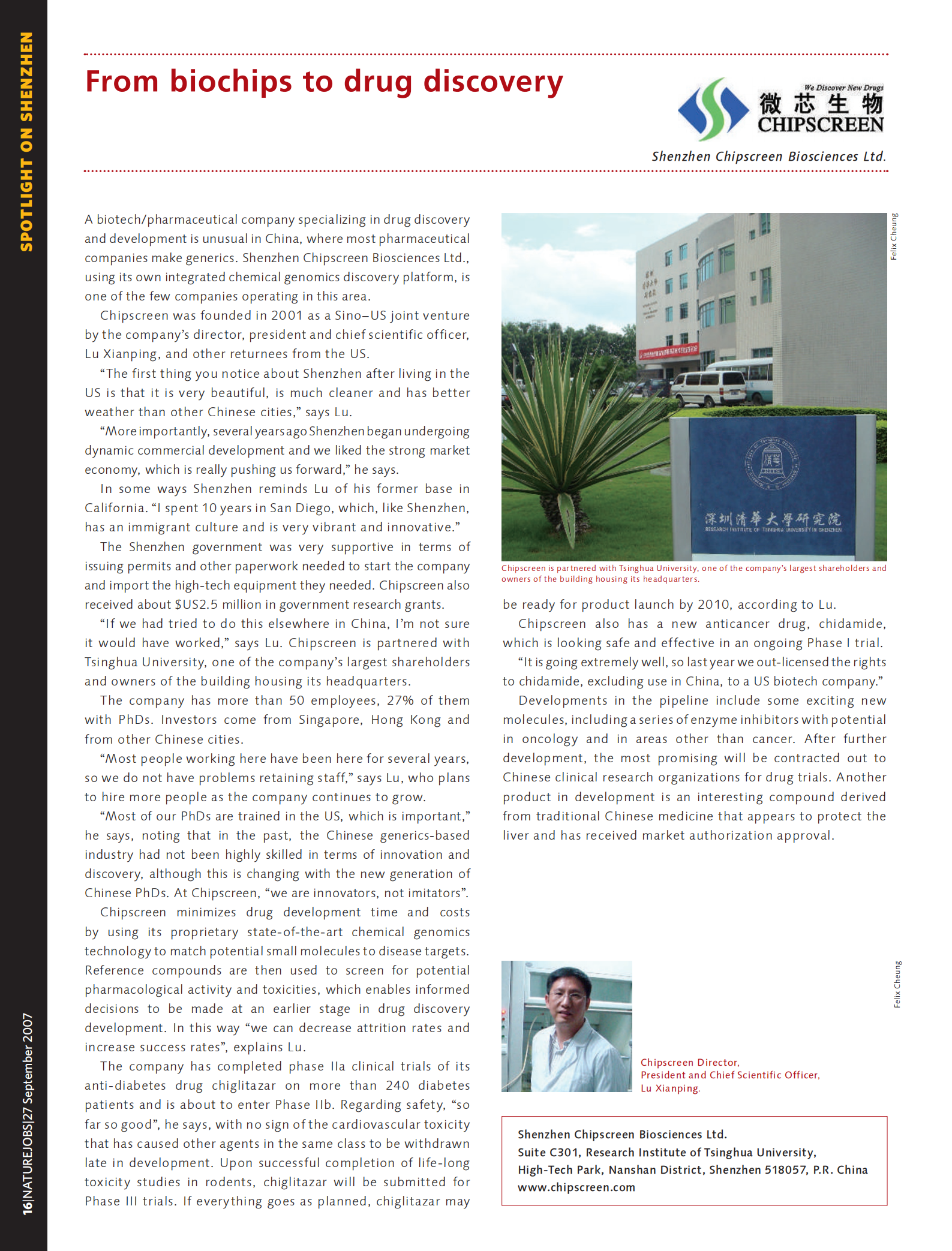
“If we had tried to do this elsewhere in China, I’m not sure it would have worked,” says Lu. Chipscreen is partnered with Tsinghua University, one of the company’s largest shareholders and owners of the building housing its headquarters.
The company has more than 50 employees, 27% of them with PhDs. Investors come from Singapore, Hong Kong and from other Chinese cities.
“Most people working here have been here for several years,so we do not have problems retaining staff,” says Lu, who plans to hire more people as the company continues to grow.
“Most of our PhDs are trained in the US, which is important,”he says, noting that in the past, the Chinese generics-based industry had not been highly skilled in terms of innovation and discovery, although this is changing with the new generation of Chinese PhDs. At Chipscreen, “we are innovators, not imitators”.
Chipscreen minimizes drug development time and costs by using its proprietary state-of-the-art chemical genomics technology to match potential small molecules to disease targets.Reference compounds are then used to screen for potential pharmacological activity and toxicities, which enables informed decisions to be made at an earlier stage in drug discovery development. In this way 《we can decrease attrition rates and increase success rates”, explains Lu.
The company has completed phase IIa clinical trials of its anti-diabetes drug chiglitazar on more than 240 diabetes patients and is about to enter Phase IIb. Regarding safety, “so far so good”, he says, with no sign of the cardiovascular toxicity that has caused other agents in the same class to be withdrawn late in development. Upon successful completion of life-long toxicity studies in rodents, chiglitazar will be submitted for Phase III trials. If everything goes as planned, chiglitazar maybe ready for product launch by 2010, according to Lu.
Chipscreen also has a new anticancer drug, chidamide,which is looking safe and effective in an ongoing Phase I trial.“It is going extremely well, so last year we out-licensed the rights to chidamide, excluding use in China, to a US biotech company.”
Developments in the pipeline include some exciting new molecules, including a series of enzyme inhibitors with potential in oncology and in areas other than cancer. After further development, the most promising will be contracted out to Chinese clinical research organizations for drug trials. Another product in development is an interesting compound derived from traditional Chinese medicine that appears to protect the liver and has received market authorization approval.
2026.04.23
2026.04.22
2026.04.21